
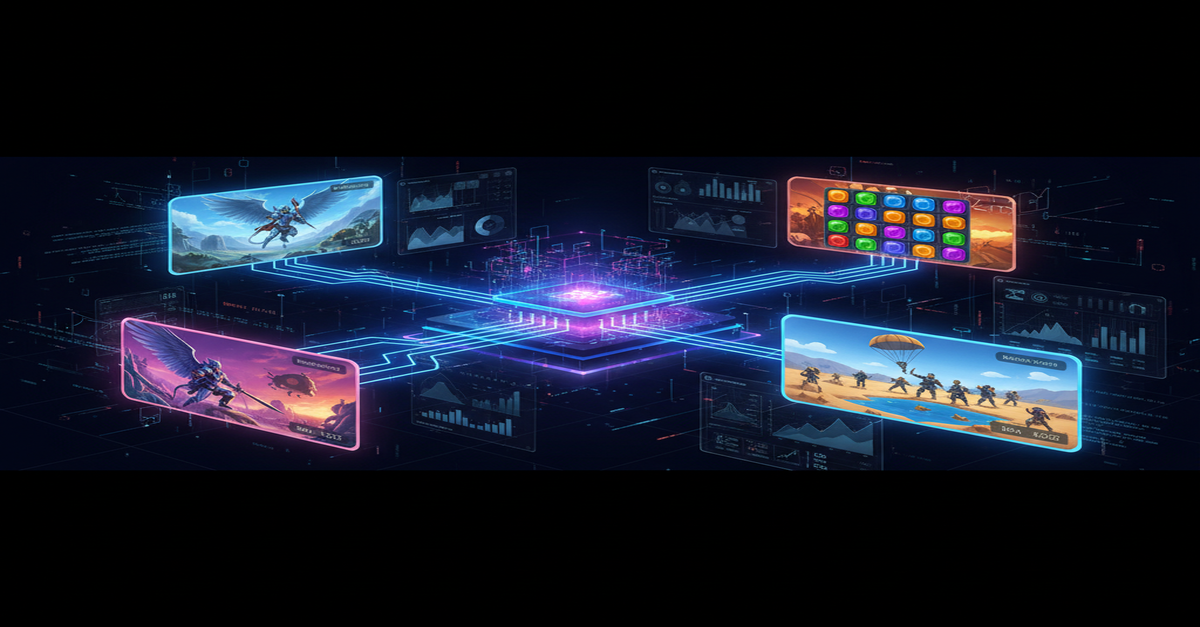
Ask any mobile game studio's UA team what their biggest bottleneck was in 2022, and most will say the same thing: creative. Specifically, the grinding, expensive, slow process of producing one-off ad creatives — a single video here, a static banner there — only to watch them fatigue in days.
Fast forward to 2026, and that model is essentially dead. The studios winning at user acquisition today have replaced it with something fundamentally different: AI-powered creative velocity. And the gap between those who've made the shift and those who haven't is widening fast.
What "Creative Velocity" Actually Means
Creative velocity isn't just about producing more ads. It's about compressing the cycle between insight and execution — being able to generate, test, learn, and iterate across dozens of creative variants simultaneously, rather than sequentially.
In the old model, a studio might ship 2–3 new creatives per week. A concept would be briefed to a designer or video editor, produced over several days, then slowly tested. By the time results came in, you'd spent weeks and thousands of dollars on something that might underperform.
In the AI-powered model, that same studio can now generate 20–50 creative variants in the time it used to take to produce one. AI tools handle concept generation, scripting, visual rendering, and even voiceovers. The human creative team shifts from production to strategy and quality control.
The Numbers Behind the Shift
The data backs this up. According to Segwise, the number of mobile game advertisers grew by 60.4% year-over-year in 2024, while ad assets rose 15.4% — a clear sign that creative output is scaling faster than headcount. A LinkedIn analysis from BrandStoryboard noted AI creative output surging 25–30% across mobile gaming advertisers in 2025 alone.
Meanwhile, Tenjin's 2026 data predicts that 50% of all mobile game ad creatives will be AI-generated by the end of the year. That's not a distant forecast — it's already the reality for the top 20% of UA teams.
Why One-Off Ads No Longer Work
The traditional one-off ad model breaks down for a few reasons that have only intensified in 2026:
- Creative fatigue is faster than ever. With algorithmic feeds on Meta, TikTok, and AppLovin's network serving billions of impressions daily, even a strong creative can saturate its audience within 5–7 days. You simply can't refresh fast enough with a manual pipeline.
- The testing math demands volume. To find a top-performing creative, you need to test many. The studios with the best UA performance are running structured creative experiments at scale — not hoping a single ad lands.
- Programmatic rewards variety. Modern DSPs and ad networks are optimized to serve the best-performing creative per user segment in real time. If you only have 3 creatives, you're leaving optimization potential on the table compared to studios running 30.
How AI Is Powering the New Pipeline
The shift isn't just about using a single AI tool — it's about rebuilding the entire creative pipeline with AI at every stage:
- Concept generation: Tools like AppAgent's AI storyboard generator and PlayTurbo analyze top-performing competitor ads, extract winning hooks, and generate fresh concept variants in minutes.
- Asset production: AI video tools can produce multiple renditions of the same concept with different characters, color palettes, or CTAs — variations that would have required separate production runs before.
- Dynamic creative optimization (DCO): Platforms now assemble creatives in real time, mixing and matching visual elements, copy, and CTAs based on which combinations are driving installs for specific user segments.
- Performance feedback loops: AI analytics tools like Segwise close the loop by automatically flagging which creative elements correlate with strong LTV, not just installs — so the next iteration is smarter, not just faster.
The Studios Making It Work
The studios at the forefront of creative velocity share a few common traits. They've moved away from treating creative as a cost center and toward treating it as a data-driven growth function. They have dedicated "creative analysts" who sit between the design team and the UA team, responsible for extracting learnings from performance data and translating them into the next creative brief — now with AI dramatically accelerating each iteration of that loop.
Admiral Media, a UA agency working with 65+ games, publicly describes their approach as shipping "three fresh concept variants per week per game" — a cadence that simply wouldn't be possible without AI-assisted production. That's the new baseline expectation for competitive UA.
What This Means for Programmatic
For the broader mobile gaming programmatic ecosystem, creative velocity changes the demand side of the equation. More creatives in market means more signals for algorithms to learn from. It means richer personalization at the impression level. And it means that programmatic platforms which can ingest, test, and optimize a high volume of creative variants will increasingly outperform those that can't.
The platforms and networks that thrive in 2026 will be those built to handle creative abundance — not creative scarcity. AppLovin's AXON engine is already designed around this reality, processing vast creative libraries and dynamically optimizing at scale. Expect more platforms to follow suit.
The Bottom Line
The one-off ad era is over. The studios still operating that way aren't just inefficient — they're structurally disadvantaged in an ecosystem where their competitors are generating 10x the creative output at a fraction of the cost.
AI-powered creative velocity isn't a nice-to-have for mobile game studios in 2026. It's table stakes. The question now is how deep the integration goes — and which teams are building the feedback loops that make each iteration smarter than the last.